Kurdistan: the other Iraq
By Anna Fifield
Published: November 11 2008. Financial Times
"………………"
The extent of corruption has undermined confidence in the Kurdish parties
Both Families, the one of Massoud and Talebani controle business and politics.
Excerpts from the article of Anna Fifield
Washington cites a lack of democratic development and endemic corruption as threats for the future of Kurdistan. “A lot of people in Baghdad are looking at Kurdistan not as a model for the future but for the mistakes they have to avoid,” says one senior American official in Baghdad. The Kurds, he adds, are “without a doubt . . . in the best position in their history. The big question among Kurds right now is, what next for us?”
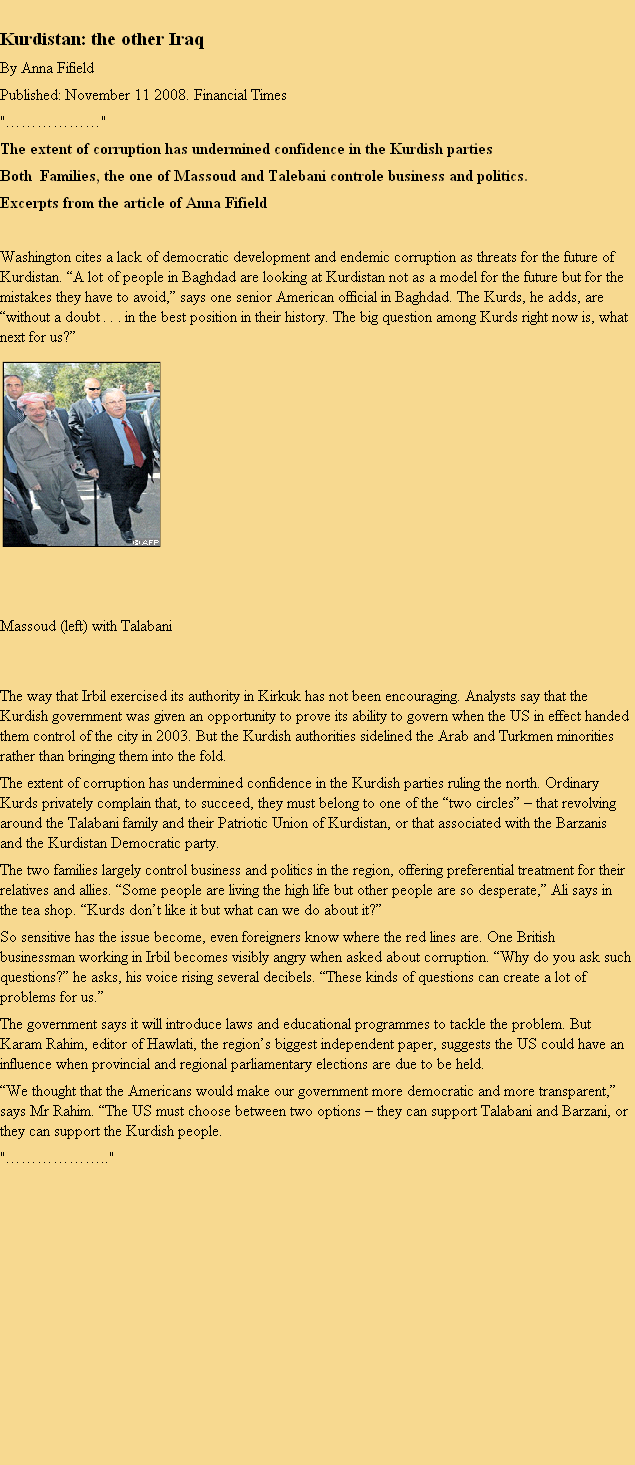
Massoud (left) with Talabani
The way that Irbil exercised its authority in Kirkuk has not been encouraging. Analysts say that the Kurdish government was given an opportunity to prove its ability to govern when the US in effect handed them control of the city in 2003. But the Kurdish authorities sidelined the Arab and Turkmen minorities rather than bringing them into the fold.
The extent of corruption has undermined confidence in the Kurdish parties ruling the north. Ordinary Kurds privately complain that, to succeed, they must belong to one of the “two circles” – that revolving around the Talabani family and their Patriotic Union of Kurdistan, or that associated with the Barzanis and the Kurdistan Democratic party.
The two families largely control business and politics in the region, offering preferential treatment for their relatives and allies. “Some people are living the high life but other people are so desperate,” Ali says in the tea shop. “Kurds don’t like it but what can we do about it?”
So sensitive has the issue become, even foreigners know where the red lines are. One British businessman working in Irbil becomes visibly angry when asked about corruption. “Why do you ask such questions?” he asks, his voice rising several decibels. “These kinds of questions can create a lot of problems for us.”
The government says it will introduce laws and educational programmes to tackle the problem. But Karam Rahim, editor of Hawlati, the region’s biggest independent paper, suggests the US could have an influence when provincial and regional parliamentary elections are due to be held.
“We thought that the Americans would make our government more democratic and more transparent,” says Mr Rahim. “The US must choose between two options – they can support Talabani and Barzani, or they can support the Kurdish people.
"……………….."